Christa Jeitner
About the Artist
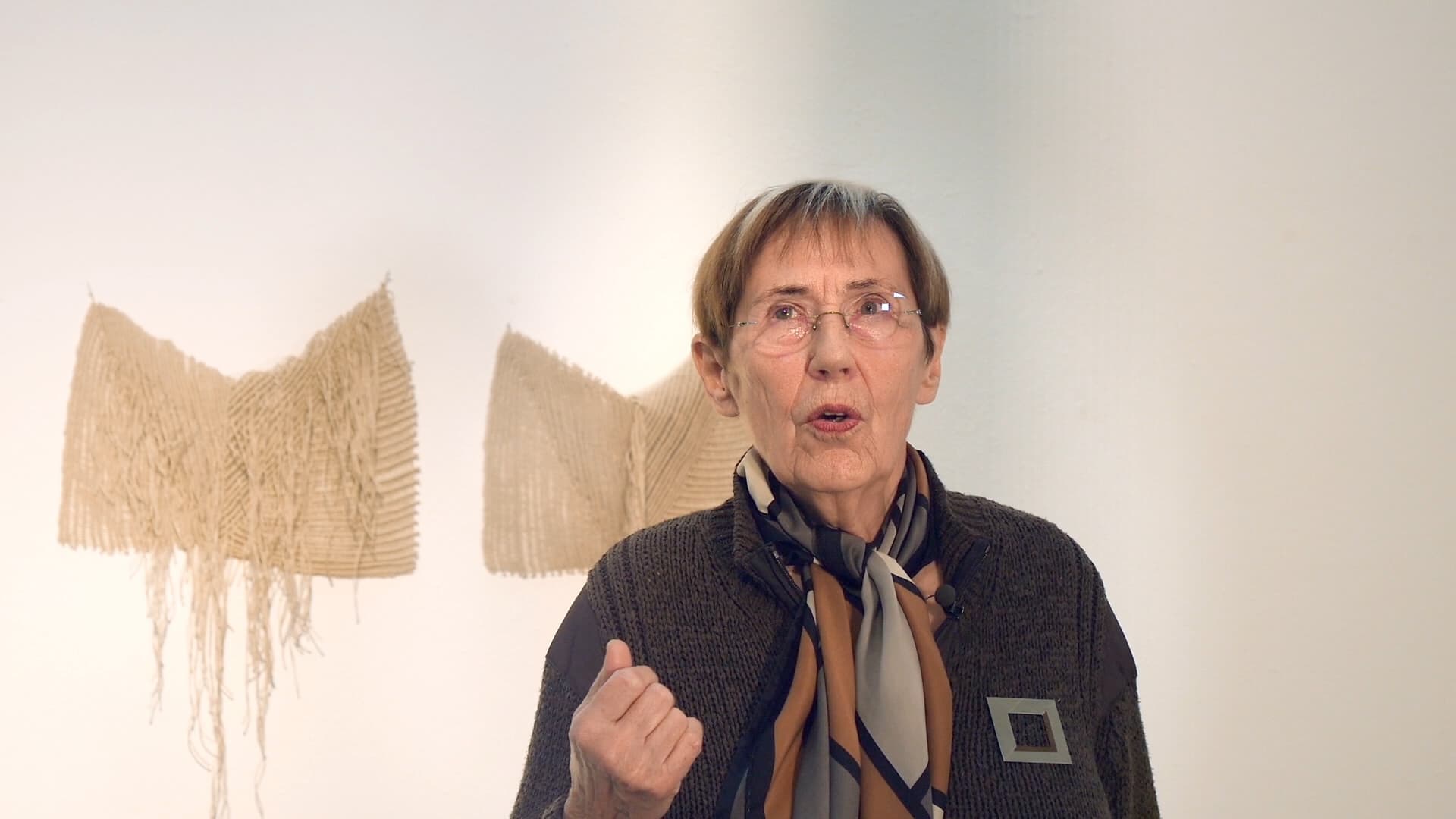
Language is also a means of reflection for the visual artist Christa Jeitner. Her practice is both artistic and political, running in tandem with a systematic reconstruc- tion of East-West German history. In 1965 she began to work as a textile restorer alongside her artistic work, to lecture and produce scholarly works. Traces of Jeitner’s parallel artistic and academic endeavors are evident in her art. Her thoughts and actions are very much shaped by dialogue. From 1969 onwards, she played an active role in “Signs of Atonement,” a group who aroused the suspicion of the East German state. In 1964, Jeitner began her Auschwitz Cycle [Auschwitz-Zyklus], a work unequalled in its use of dialectic abstraction and narration. The cycle recorded
the horror in small, rectangular assemblages, transposing it into objectlike, tactile images – images that avoid language through their use of material. The objects selected for the exhibition are contemporary works. The two Bedouin Souvenirs [Beduinische Erinnerungsstücke] (2009), pieces of hosepipe wrapped in wire, form part of a cycle with everyday objects taken from one of Jeitner’s journeys to the Sinai. The way Jeitner approached the second work, titled Seams of a Camel Bag (“my mother did it for me”) [Nähte eines Kamelsacks (“my mother did it for me”)], is almost archaeological: by cutting away the main surface of an industrial fabric, Jeitner draws our attention to the seam, the trace of a human hand. The purpose of the material fades into the background; what we now see is how it has been sewn and patched. Re-Rester – Wire and Denim [Re- Rester. Draht und Denim: Verfestigte Halde] (2016) comprises of wire and jeans, between them is a glove, caught inside by chance. Jeans – a global cult product once reserved for the American workingman, now, a universally-available mass- commodity. Before our eyes, the object is inexorably transformed into a body lying on the ground, directing our thoughts
to images of clothing fragments caught in the fences dividing the world’s rich and poor. The frequent yet minimal interventions in Jeitner’s work both highlight
the properties of the material, and allow the cultural history of such techniques to emerge.